By Prince Ukpong Idiong Jr.
Nigeria’s railway renaissance represents one of the Federal Government’s most ambitious infrastructure programmes in decades. From the Lagos-Ibadan standard gauge to the Abuja-Kaduna corridor, the Warri-Itakpe line, the rehabilitation of the Port Harcourt-Maiduguri Eastern Line, and other planned rail expansions, the country is gradually rebuilding a transportation system that had suffered decades of neglect. The vision is clear: connect Nigeria, stimulate commerce, reduce logistics costs, and accelerate national development.
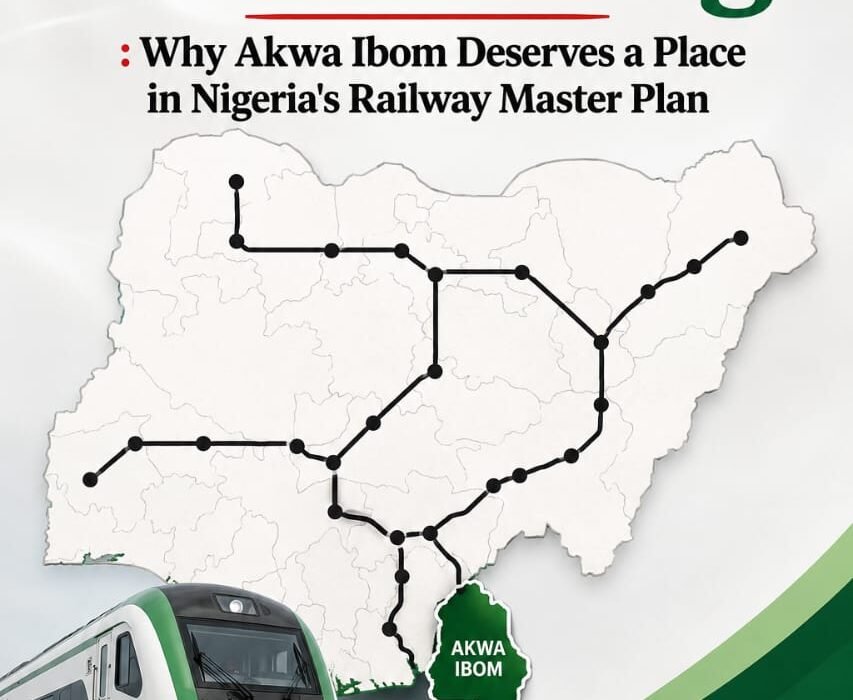
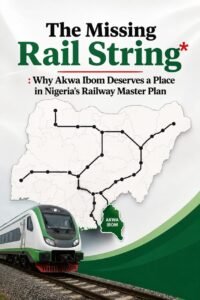
Yet, amid this renewed investment in rail infrastructure, one glaring omission continues to provoke legitimate questions. Akwa Ibom State ,one of Nigeria’s foremost economic hubs remains outside the country’s operational and proposed railway network. As the national railway map continues to evolve, the absence of a rail station or direct rail corridor into Akwa Ibom deserves thoughtful national attention.
This is not merely an Akwa Ibom concern. It is a national planning issue. Infrastructure of this magnitude should reflect both economic realities and balanced regional development. Every state may not receive identical projects at the same time, but strategic economic centres should not remain disconnected from the country’s principal transportation network.
Across Nigeria, federal rail investments have deliberately linked major commercial and industrial corridors. Lagos serves as the nation’s commercial capital. Kano remains Northern Nigeria’s trading hub. Kaduna functions as a strategic industrial centre. Rivers State benefits from the Eastern Railway corridor through Port Harcourt. Delta State hosts the Warri-Itakpe railway. These projects recognise the economic importance of connecting production centres with markets.
The logic behind these investments is undeniable. Railways reduce transportation costs, improve cargo movement, encourage industrial growth, stimulate private investment, and create employment. Every economy that has successfully industrialised has relied on efficient rail transportation as a critical component of national productivity.
Against this backdrop, Akwa Ibom presents an interesting contradiction. The state has invested heavily in roads, aviation infrastructure, hospitality, agriculture, education, and industrial development. It hosts one of Nigeria’s busiest airports, possesses significant oil and gas assets, and continues to position itself as an investment destination. Yet one major transportation pillar remains absent—rail connectivity.
For manufacturers, exporters, farmers, construction companies, and logistics operators, this omission carries significant consequences. Heavy cargo that could efficiently move by rail must instead depend almost entirely on road transportation, increasing operational costs, delivery times, and pressure on already overstretched highways.
Perhaps the most encouraging development in recent weeks came from Abia State Governor Alex Otti. Speaking during his monthly media briefing, Governor Otti revealed that South-East states, together with parts of the South-South, are discussing a regional railway network linking Port Harcourt, Aba, Enugu, Imo, and Akwa Ibom. His remarks introduced a refreshing shift from isolated state planning toward regional economic cooperation.
Governor Otti disclosed that Abia had initially planned an independent light rail project with the support of a Chinese company. However, after careful evaluation, his administration concluded that constructing rail infrastructure without integrating neighbouring states would not maximise economic benefits. Consequently, the stand-alone project was suspended in favour of a broader regional approach.
That decision demonstrates strategic thinking. Modern infrastructure planning must extend beyond political boundaries. States do not develop in isolation; economies grow through interconnected markets, shared logistics, and regional cooperation.
The proposed South-East and South-South regional railway initiative deserves serious consideration by the Federal Government because it complements not competes with the national Railway Master Plan. Integrating regional aspirations into federal infrastructure planning would strengthen Nigeria’s transportation network while promoting inclusive development.
For Akwa Ibom, inclusion in such a network would be transformative. A rail connection extending from the existing Port Harcourt corridor into Uyo and beyond would integrate the state into Nigeria’s wider commercial ecosystem, facilitate interstate trade, and improve access for businesses operating within the region.
Such connectivity would also strengthen ongoing industrial ambitions. Whether in agriculture, manufacturing, petroleum services, tourism, or maritime activities, investors consistently prioritise efficient logistics before committing capital. Reliable rail access reduces costs and enhances competitiveness.
It is important to recognise that this conversation should not be reduced to politics or regional sentiment. Rather, it should focus on economic efficiency and national interest. Infrastructure planning achieves its greatest value when projects are guided by objective economic indicators rather than short-term political considerations.
The South-East and South-South have every reason to deepen collaboration. These neighbouring regions share commercial relationships, transport corridors, ports, industries, educational institutions, and cultural ties. Their economic fortunes are increasingly interconnected. A regional railway system would strengthen all participating states rather than favour one at the expense of another.
National development should not create isolated islands of infrastructure. Instead, it should produce connected corridors of growth capable of supporting commerce across multiple states simultaneously. Every additional rail connection expands opportunities for businesses, workers, and consumers alike.
The Federal Government has repeatedly demonstrated its commitment to infrastructure renewal. The next phase should therefore emphasise inclusivity by ensuring that economically strategic states currently outside the railway network are progressively integrated into future implementation phases.
Akwa Ibom’s case is strengthened not only by its current economic profile but also by its future potential. As Nigeria pursues economic diversification, the state offers opportunities in manufacturing, petrochemicals, agriculture, blue economy initiatives, tourism, and export-oriented industries. Rail connectivity would significantly enhance these prospects.
History has shown that transportation infrastructure often determines where industries choose to locate. Businesses naturally establish operations where logistics are efficient and transportation costs remain competitive. Rail access therefore influences investment decisions long before factories are built.
The ongoing conversations among regional leaders provide an opportunity to rethink infrastructure development beyond administrative boundaries. Rather than allowing political differences to hinder cooperation, governments across the South-East and South-South should continue working together toward a common transportation vision that benefits millions of Nigerians.
Ultimately, the inclusion of Akwa Ibom in Nigeria’s Railway Master Plan is not a request for special treatment. It is a call for strategic completeness. A national railway system should reflect the realities of Nigeria’s evolving economy by connecting every major commercial and industrial hub capable of driving national prosperity.
As Nigeria lays the tracks that will define its economic future, the measure of success will not simply be the number of kilometres constructed. It will also be whether those tracks unite the nation’s productive regions, promote balanced development, and ensure that no economically significant state is left disconnected. In that national vision, Akwa Ibom deserves more than hope, it deserves a place on the map.