
By Prince Ukpong Idiong Jr.
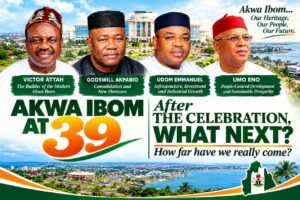
Thirty-nine years after its creation on September 23, 1987, Akwa Ibom has every reason to celebrate.
But after the celebration comes the reflection.
After the speeches come the questions.
After the anniversary banners come the balance sheet.
And after the applause, we must ask ourselves one uncomfortable but necessary question:
How far have we really come—and where are we going from here?
Anniversaries are not merely occasions for thanksgiving. They are moments for taking stock. They allow societies to look beyond ceremonies, political speeches and impressive photographs and examine the realities beneath the surface.
What have we built?
What have we produced?
What have we created?
Where are the investments?
Where are the jobs?
How many of our young people are economically productive?
And perhaps the most important question of all:
How much of Akwa Ibom’s enormous potential are we actually converting into wealth and opportunity for our people?
AKWA IBOM HAS A CONVERSION PROBLEM
Let us be clear: Akwa Ibom is not without resources.
We have oil and gas.
We have a long coastline.
We have fertile agricultural land.
We have tourism and cultural assets.
We have a growing urban economy.
We have educated young people.
We have entrepreneurs.
We have aviation infrastructure.
We have hospitality facilities.
We have construction and real-estate activity.
We have creative talent.
We have access to regional markets.
And we have the potential for a maritime economy.
But natural resources do not develop themselves.
Oil beneath the ground does not automatically become employment.
A coastline does not automatically become a blue economy.
Fertile land does not automatically become an agricultural industry.
Cultural heritage does not automatically become a tourism business.
And educated young people do not automatically become a productive workforce.
There must be capital, enterprise, technology, infrastructure, policy, skills and deliberate investment.
That is where the real conversation begins.
Akwa Ibom’s challenge is increasingly not simply what we possess.
It is how quickly and effectively we convert what we possess into production, businesses, employment and wealth.
WHERE ARE THE INVESTMENTS? WHERE ARE THE JOBS?
This should be one of the defining questions of our 39th anniversary.
Where are the investments, and where are the employment opportunities?
It is a simple question, but it cuts deeply.
A state can build roads.
It can construct schools.
It can commission hospitals.
It can beautify cities.
It can build public infrastructure.
All of these matter.
But the economy becomes truly sustainable when private capital begins to multiply around those investments.
A road should create commerce.
An airport should create an aviation ecosystem.
A power project should support industry.
A tourism asset should generate hospitality businesses.
Agricultural infrastructure should produce processors and markets.
A technology hub should produce companies.
And a major government investment should attract several layers of private investment around it.
That is the difference between spending money and building an economy.
WE MUST BEGIN TO BUILD AS INDIGENOUS COMPANIES
There is another conversation we must have honestly as Akwa Ibom people.
We must begin to build here.
There is nothing wrong with Akwa Ibom people investing in Lagos.
There is nothing wrong with investing in Abuja.
There is nothing wrong with buying property abroad or establishing businesses outside Nigeria.
Capital naturally follows opportunity.
But if almost all our major private investments mature elsewhere, we must ask ourselves what that means for the economic future of our own state.
If our entrepreneurs make money here but establish their biggest businesses elsewhere, where will the jobs be created?
If our professionals accumulate capital but invest it outside the state, who will build the industries here?
If our wealthy citizens buy properties elsewhere but do not sufficiently develop businesses at home, how do we create a deeper local economy?
And then we ask:
How do we expect overseas investors and international partners to come to Akwa Ibom when our own people are not sufficiently confident to anchor their capital here?
This is not an accusation against our people.
It is a development challenge.
Investment confidence must begin at home.
We need indigenous companies that can grow from Akwa Ibom into national and international businesses.
We need companies that employ thousands, not merely companies that chase government contracts.
We need manufacturers.
Technology companies.
Agricultural processors.
Logistics firms.
Construction companies.
Real-estate developers.
Tourism businesses.
Maritime enterprises.
Creative businesses.
Financial and professional-service companies.
Digital enterprises.
We need Akwa Ibom capital building Akwa Ibom capacity.
THE GOOD NEWS: WE ARE NOT STARTING FROM ZERO
A fair reflection must also recognise the companies and institutions that have continued to put economic activity into the state.
They deserve acknowledgement.
In transportation and aviation, Ibom Air, AKTC, Nsit Motors and Sea Express represent important pieces of the state’s mobility and connectivity ecosystem.
Ibom Air is particularly instructive because it demonstrates what happens when infrastructure, public investment and indigenous human-capital development are connected. In September 2026, the state government said Ibom Air and the wider aviation ecosystem had created about 2,000 direct jobs, while also reporting that 14 of the airline’s 30 pilots and 16 of its 40 aircraft engineers were Akwa Ibom indigenes trained with state support.
That is more than an aviation story.
It is an economic-development lesson:
Investment should not only bring assets; it should produce people, skills, businesses and jobs.
In oil and gas, companies such as Frontier Oil Limited represent the continuing role of private enterprise in one of Akwa Ibom’s traditional economic sectors.
In manufacturing and consumer goods, Champion Breweries Plc, Semek Group and Bellanath Organic Nigeria Limited, among others, demonstrate the importance of having productive enterprises operating within the state.
In construction and physical development, Ubotex Group, Hensek, Nsik and U&K represent the indigenous capacity participating in the construction economy.
In hospitality, investments such as Four Points by Sheraton, Ibom Icon Hotel & Golf Resort, Villa Marina, Monty Suites and South Hills add to the ecosystem required to support tourism, conferences, business travel and leisure.
These businesses operate at different scales and in different sectors, but collectively they tell us something important:
Akwa Ibom is not empty of enterprise.
The challenge is to move from a handful of notable enterprises to a much deeper ecosystem of thousands of competitive indigenous businesses.
THE CREATIVE ECONOMY MUST NOT BE LEFT BEHIND
There is another economic frontier we must stop treating as mere entertainment.
Our creative industry is an economy.
Akwa Ibom has broadcasters, filmmakers, musicians, content creators, photographers, fashion entrepreneurs, event professionals, digital communicators and other creative practitioners.
Names such as AKBC, Planet FM, Comfort FM and Sensor News, alongside our Nollywood actors, producers, musicians and emerging digital creators, form part of a growing creative ecosystem.
This sector deserves more than applause.
It deserves investment.
It deserves infrastructure.
It deserves intellectual-property protection.
It deserves professional management.
It deserves financing.
And it deserves market access.
Nigeria’s wider creative economy is already attracting international capital, while federal policy initiatives are increasingly treating film, music, fashion, digital content, gaming and related industries as economic sectors rather than merely cultural activities.
Akwa Ibom must position its own creative talent to participate in that economy.
The question should no longer be:
“Who is the next Akwa Ibom musician or actor?”
It should be:
“Where is the Akwa Ibom creative company that will employ 500 people?”
Where is the film studio?
Where is the animation company?
Where is the music publishing company?
Where is the digital-content export company?
Where is the indigenous streaming platform?
Where are the production facilities?
Where are the creative-tech investors?
The talent is here.
The economic architecture must catch up.
FROM NATURAL RESOURCES TO INDUSTRIAL CAPACITY
For decades, oil has dominated our economic conversation.
But the future cannot depend exclusively on extracting what is beneath our soil.
We must move from extraction to production.
From crude resources to processed products.
From farmers to agro-industrialists.
From fishermen to a modern fisheries and aquaculture industry.
From coastline to maritime commerce.
From tourism attractions to tourism businesses.
From educated graduates to skilled professionals and entrepreneurs.
From government expenditure to private-sector multiplication.
This is why the state’s current investment facilitation efforts deserve attention. The Akwa Ibom Investment Facilitation Desk was inaugurated in 2026 to streamline investment processes, improve investor engagement and support private capital and job creation.
AKICORP also operates an investment-appraisal structure and says projects can be supported through direct investment or referral to financing mechanisms, including a reported ₦4 billion State Government/Bank of Industry MSME fund.
These mechanisms matter.
But ultimately, the scoreboard must be visible in the economy:
How many businesses entered?
How much capital came in?
How many factories opened?
How many local companies expanded?
How many people got sustainable jobs?
How many businesses survived five and ten years?
That is where economic development becomes measurable.
RAPID DEVELOPMENT IS NOT A LUXURY
Akwa Ibom cannot afford to develop at the speed of yesterday while the rest of the world is moving at the speed of tomorrow.
Capital is mobile.
Technology is mobile.
Talent is mobile.
Investors are mobile.
Young people are mobile.
If we take too long to convert opportunities into industries, other locations will capture the investment.
That is why rapid development should not mean reckless development.
It should mean deliberate development with speed, measurable targets and accountability.
We need to move faster in attracting investment.
Faster in supporting indigenous businesses.
Faster in developing industrial clusters.
Faster in technical education.
Faster in agriculture.
Faster in digital infrastructure.
Faster in tourism.
Faster in maritime development.
Faster in connecting rural producers to markets.
And faster in turning our infrastructure into productive economic assets.
AKWA IBOM MUST BECOME MORE THAN A CONSUMER MARKET
One of our biggest economic challenges is becoming a strong producer.
We consume.
We import.
We buy.
We celebrate.
But how much do we manufacture?
How much do we process?
How much do we export?
How many products carrying an unmistakable “Made in Akwa Ibom” identity are found across Nigeria and beyond?
That is the challenge.
A strong state economy cannot be built on government salaries, contracts and consumption alone.
It requires production.
It requires companies.
It requires capital.
It requires markets.
It requires innovation.
And it requires people willing to take risks.
DEVELOPMENT MUST REACH ALL 31 LGAs
Akwa Ibom is bigger than Uyo.
The development conversation must therefore extend beyond the state capital.
Every local government should be able to identify its economic advantage.
What can Ikot Ekpene produce at scale?
What can Eket become in the energy and industrial value chain?
What can Oron become in maritime commerce and fisheries?
What opportunities exist in Ibeno beyond petroleum?
What can Uyo build around services, technology, education, hospitality and creative industries?
What can our rural communities produce, process and sell?
The state has itself identified investment opportunities across sectors including agriculture, oil and gas, aviation, power, real estate and the blue economy, with comparative advantages across the 31 LGAs.
The next step is ensuring that those comparative advantages become commercial advantages.
FROM PROJECT COMMISSIONING TO ECONOMIC IMPACT
We must also change how we measure public development.
When a project is commissioned, the question should not end with:
“How beautiful is it?”
We should ask:
Who will use it?
Who will maintain it?
How many jobs will it create?
How many businesses will emerge around it?
What private investment will it attract?
What economic value will it produce after five years?
What will it look like after ten years?
This is particularly important because public infrastructure becomes more valuable when it stimulates private enterprise.
The ultimate objective should not simply be to construct assets.
It should be to construct an economy.
THE YOUTH QUESTION
Perhaps nowhere is this conversation more urgent than among our young people.
A university certificate is valuable, but it is not an economic system.
We need technical skills.
Vocational education.
Digital skills.
Entrepreneurship.
Apprenticeships.
Research.
Innovation.
Access to finance.
Mentorship.
Market connections.
And, importantly, respect for skilled labour.
The electrician, welder, plumber, mechanic, fashion designer, farmer, builder, software developer, filmmaker, musician, photographer and digital entrepreneur are all economic actors.
A state that trains people without creating economic pathways for them will eventually train people to leave.
Our ambition should be to create an economy that gives our young people reasons to stay.
THE GRASSROOTS ECONOMY
Development must also be felt outside major urban centres.
A farmer cannot be productive if his produce cannot reach the market.
A rural entrepreneur cannot expand without electricity, connectivity and finance.
A small manufacturer cannot compete if logistics costs consume the profit.
A creative entrepreneur cannot reach global customers without digital infrastructure.
The rural economy must therefore become part of the state’s growth strategy.
Development becomes meaningful when the ordinary citizen can feel it—not merely when it appears in an official report.
WHAT SHOULD THE NEXT 39 YEARS LOOK LIKE?
The next 39 years should be about moving from infrastructure-led development to productive economic development.
More indigenous companies.
More manufacturing.
More agro-processing.
More tourism enterprises.
More maritime businesses.
More technology companies.
More creative enterprises.
More competitive construction companies.
More investment in human capital.
More access to finance.
More exports.
More private capital.
More jobs.
And stronger institutions capable of sustaining progress beyond individual administrations.
We should build an Akwa Ibom where government remains an important facilitator, but where the private sector increasingly becomes a major engine of employment and production.
THE SPARKLING REFLECTION
Akwa Ibom at 39 deserves celebration.
But it also deserves honesty.
We should celebrate our roads without pretending every road is fixed.
We should celebrate our schools while acknowledging the gaps.
We should celebrate Ibom Air while asking what other indigenous companies can become the next Ibom Air.
We should celebrate our hotels while asking how many more tourism businesses can grow around them.
We should celebrate our oil resources while preparing seriously for a diversified economy.
We should celebrate our entrepreneurs while creating conditions for thousands more to emerge.
We should celebrate our creative talents while asking how to turn talent into companies, intellectual property and exports.
And we should celebrate our development without becoming prisoners of what we have already achieved.
Because 39 years is not the end of the story.
It is a point of reflection.
The real question is not whether Akwa Ibom has progressed.
It clearly has.
The more difficult question is whether the pace, depth and quality of that progress are sufficient for the opportunities before us.
We cannot afford to have all our biggest investments in Lagos, Abuja and outside the country while asking international investors to discover the opportunities in our own backyard.
We must build confidence at home.
We must build companies at home.
We must build industries at home.
We must create value at home.
And when international partners come, they should not come merely to extract opportunities from Akwa Ibom.
They should come to partner with Akwa Ibom companies, employ Akwa Ibom people, develop Akwa Ibom industries and connect Akwa Ibom products to the world.
That is the kind of investment ecosystem we should be building.
Because natural resources do not develop themselves.
People do.
Capital does.
Enterprise does.
Innovation does.
Industry does.
And ultimately, employment does.
So, after the celebration, what next?
Where are the investments?
Where are the jobs?
Where are the indigenous companies?
Where is the production?
Where are the exports?
And perhaps the biggest question:
What are we going to build in the next 39 years that will make the next generation look back and say—we did not merely inherit Akwa Ibom; we expanded its possibilities?
Akwa Ibom is 39.
The celebration is necessary.
But the work ahead is greater.
The future will not be built by potential alone. It will be built by investment, enterprise, innovation, production and people willing to build.
Prince Ukpong Idiong Jr, a public affairs analyst, based in Abuja-Nigeria.