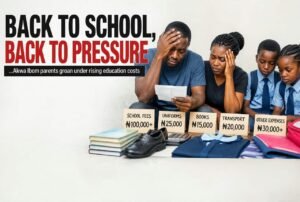
 ….When educational aspirations collide with the pressure on families.
By Prince Ukpong Idiong Jr.
As schools reopen, parents confront a familiar September dilemma: how to secure quality education for their children without sinking deeper into financial distress returns to the minds of every parent in Nigeria.
The return to school has traditionally been associated with excitement, new uniforms, fresh notebooks, renewed friendships and the promise of another academic chapter. But in today’s economic climate, the familiar rhythm of resumption has acquired a more troubling dimension. For many Nigerian families, particularly in Akwa Ibom State, “back to school” is no longer simply an educational routine; it has become a major financial event that requires months of planning, sacrifice and difficult choices.
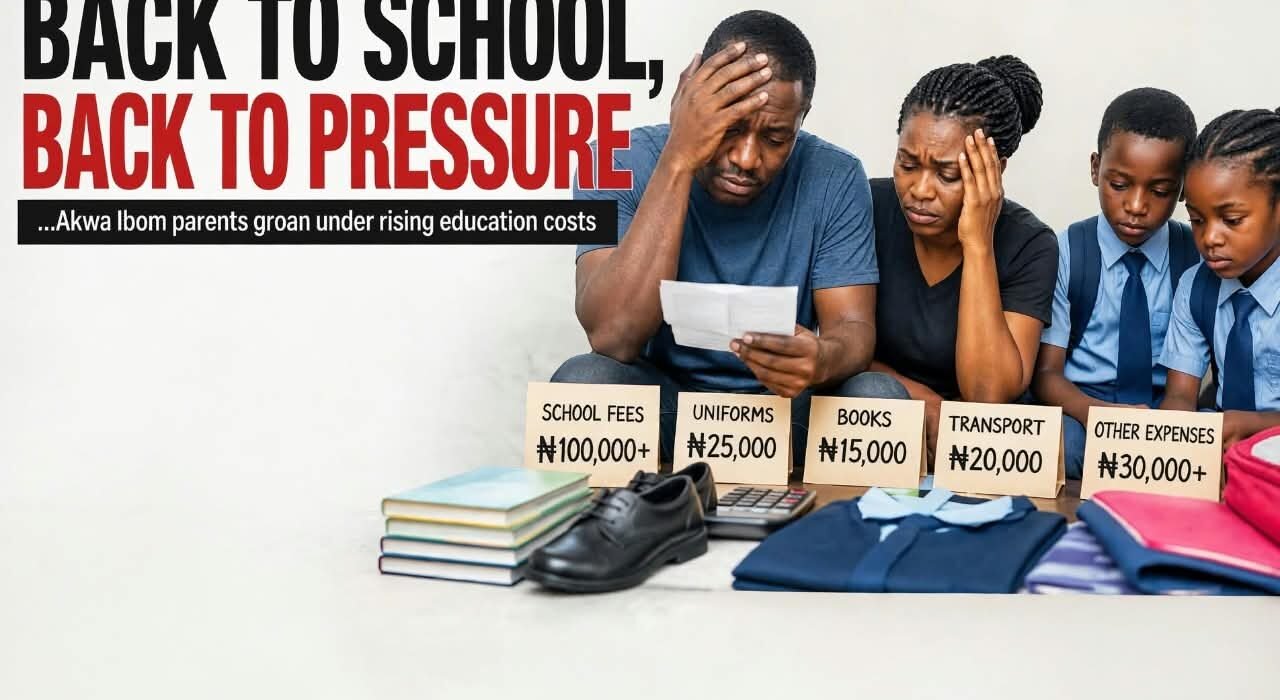
Across households, the pressure is already palpable. Families are contending with rising food prices, transportation costs, accommodation, healthcare expenses, electricity bills and other basic necessities. Then comes September, bringing with it school fees, textbooks, uniforms, shoes, bags, lesson fees, examination charges, transportation and other associated educational expenses.
The question confronting many parents is therefore not whether their children should go to school. That decision is hardly negotiable. The real question is: how can parents continue to provide quality education for their children without compromising the family’s ability to survive?
In Akwa Ibom State, school fees from kindergarten through secondary education can run into ₦100,000 and above per child, depending on the school, location, facilities and perceived standard of education. While there are schools offering different fee structures, the reality remains that quality education increasingly comes with a substantial financial commitment.
For a family with four school-age children, the arithmetic can become particularly intimidating. A seemingly manageable school bill for one child can quickly become a significant financial burden when multiplied across four children. And school fees represent only one part of the equation.
Parents must also provide uniforms, textbooks, writing materials, footwear, school transportation, feeding money and other compulsory or incidental expenses. When these costs accumulate, the beginning of a new academic session can place enormous pressure on household income.
This is where the conversation about education must move beyond the simplistic argument that parents should “provide for their children.” Parents are already trying. Many are working longer hours, running multiple businesses, taking loans, cutting down on personal expenses and postponing important family projects simply to keep their children in school.
The emerging reality is that the Nigerian parent is increasingly financing education under economic pressure rather than economic comfort.
There is also a psychological dimension to this crisis. Parents naturally want the best for their children. They want them in schools where they can receive sound academic training, develop confidence, access technology, participate in extracurricular activities and compete favourably with their peers. But the desire to provide the best can sometimes collide painfully with what the family income can realistically sustain.
This creates a difficult social dilemma. Should parents choose an expensive school because of its reputation, facilities and academic record, or should they opt for a more affordable institution that allows the family to remain financially stable?
There is no universal answer. But one principle should remain constant: education should improve the future of a child without destroying the present stability of the family.
The current situation also demands introspection from school proprietors. While schools have their own operational challenges, including salaries, infrastructure, utilities, instructional materials, security and regulatory requirements, fee increases should be approached with sensitivity to the economic circumstances of the families they serve.
There is a need for greater transparency in school charges. Parents should understand exactly what they are paying for, while schools should distinguish between essential educational expenses and charges that can reasonably be deferred or made optional.
Government, too, cannot remain a distant observer. The pressure on private schools is partly a reflection of the limitations within the public education system. Strengthening public schools with qualified teachers, functional infrastructure, digital learning resources and effective supervision would provide parents with credible alternatives and reduce the desperation to secure expensive private education at all costs.
For Akwa Ibom State, where human capital development remains central to the state’s long-term economic prospects, education should be treated not merely as a private family responsibility but as a strategic investment in the state’s future.
There is equally a role for financial institutions, employers, communities and civil society organisations. Innovative education-support schemes, low-interest school-fee loans, scholarship programmes, flexible payment arrangements and targeted assistance for vulnerable households could provide meaningful relief.
Schools could also consider structured payment plans that allow parents to spread fees across several months rather than demanding large lump-sum payments at resumption. Such arrangements would not eliminate the financial burden, but they could make it significantly more manageable.
Parents, on their part, must also embrace realistic financial planning. Education should be incorporated into household budgeting throughout the year rather than treated as an emergency expense whenever school resumes. Where possible, parents should create dedicated education funds and distinguish between essential educational needs and expenses driven primarily by social pressure.
Perhaps most importantly, parents must resist the temptation to measure their success by the brand name of the school their children attend. A prestigious school does not automatically guarantee a successful child, just as an affordable school does not automatically produce an unsuccessful one. The quality of parenting, discipline, values, mentorship and the child’s own commitment to learning remain enormously important.
The “back-to-school” season should therefore provoke a wider national conversation. It should make us ask whether the cost of educating a child is becoming disproportionately high relative to household earnings, and what can be done to prevent education from becoming another source of household indebtedness.
For families with four children, the challenge is even more pronounced. The combined financial obligations can consume a substantial portion of household income, particularly where parents are also paying rent, supporting extended family members and meeting other essential needs.
Yet, despite these pressures, Nigerian parents continue to make extraordinary sacrifices for their children. That resilience deserves recognition. But resilience should not become an excuse for a system that continuously pushes families to the edge.
Education is an investment, but the investor must also remain financially alive.
As schools reopen across Akwa Ibom and Nigeria, the priority should therefore be a more compassionate and sustainable educational ecosystem—one where schools remain viable, teachers are adequately supported, children receive quality education and parents are not forced to choose between paying school fees and feeding their families.
The new school term should bring hope, not fear. It should be a season of renewed opportunity for children, not a recurring financial crisis for their parents.
Ultimately, the measure of a responsible society is not simply how many children it sends to school, but how sustainably it creates an environment in which every child can receive quality education without turning the family home into a permanent battlefield of financial survival.
Prince Ukpong Idiong Jr.
A public affairs analyst based in Abuja-Nigeria.