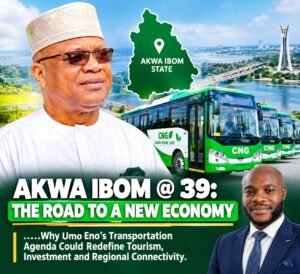
…..Why Umo Eno’s Transportation Agenda Could Redefine Tourism, Investment and Regional Connectivity.
By Prince Ukpong Idiong Jr.
Akwa Ibom’s 2026 anniversary should not merely be a celebration of the state’s past. It should be an interrogation of its future.
And if there is one sector through which that future can be most strategically examined, it is transportation.
The central argument is straightforward: Governor Pastor Umo Eno’s transportation interventions are beginning to represent something larger than mobility projects. They are becoming the connective infrastructure for a new Akwa Ibom economy, one driven increasingly by tourism, investment, regional commerce and inclusive enterprise.
This distinction matters.
Governments acquire buses. Governments rehabilitate roads. Governments develop airports and transport terminals. But development occurs when infrastructure is deliberately connected to an economic vision.
That is the opportunity now before Akwa Ibom.
THE REAL ASSET IS CONNECTIVITY
Akwa Ibom does not lack economic potential.
It has a coastline, cultural heritage, tourism attractions, agricultural capacity, human capital, an international airport and a strategic location within the South-South, with access to the South-East market.
What has often been missing is the connective tissue capable of turning these individual advantages into a functioning economic ecosystem.
Transportation can provide that tissue.
A tourist destination is only as valuable as its accessibility. An investment destination is only as competitive as its logistics. Agricultural production means little if farmers cannot efficiently reach markets. Manufacturing requires dependable movement of raw materials and finished products.
In other words:
The economy moves when transportation works.
This is why the development of the state’s aviation, road, marine and potential rail connections deserves to be considered collectively rather than as separate government projects.
THE SKY: IBOM AIR AND THE AVIATION ADVANTAGE
The development of Akwa Ibom’s airport infrastructure and the emergence of Ibom Air have already given the state an important aviation advantage.
Ibom Air is more than an airline carrying passengers into and out of Uyo. Properly leveraged, it is an economic bridge between Akwa Ibom and other Nigerian markets.
For tourism, aviation reduces distance.
For investors, it improves accessibility.
For businesses, it makes movement more predictable.
For government, it strengthens the state’s competitiveness as a destination.
The strategic question is therefore no longer simply whether Akwa Ibom has an airline. It is whether the state can use its aviation advantage to attract more visitors, businesses, conferences, investments and regional economic activity.
THE SEA: TURNING WATER INTO A CORRIDOR OF OPPORTUNITY
The introduction of Blue Marine boat services connecting Akwa Ibom with Calabar adds another important dimension.
For decades, the state’s waterways have represented an underexploited economic opportunity.
Efficient marine transportation can change that equation.
The connection to Cross River offers possibilities for passenger mobility, tourism circuits and broader commercial interaction between neighbouring states.
The significance is even greater when viewed through the lens of tourism.
Akwa Ibom and Cross River do not have to compete for every visitor.
They can collaborate to create a broader South-South tourism experience in which destinations complement rather than cannibalize one another.
The sea can become a highway.
THE RAIL: THINKING BEYOND AKWA IBOM’S BORDERS
The emerging collaboration among South-East and South-South states around regional rail development takes the argument further.
The most competitive economies of the future will not be built by states thinking only within their borders.
Regional integration matters.
A functional rail corridor can connect production centres to markets, move people more efficiently and reduce the logistical burden associated with long-distance road transportation.
For Akwa Ibom, such connectivity could expand access to markets across the South-East and South-South while strengthening its position as a regional economic gateway.
This is where transportation policy becomes economic strategy.
THE ROAD: CNG AND THE DEMOCRATISATION OF MOBILITY
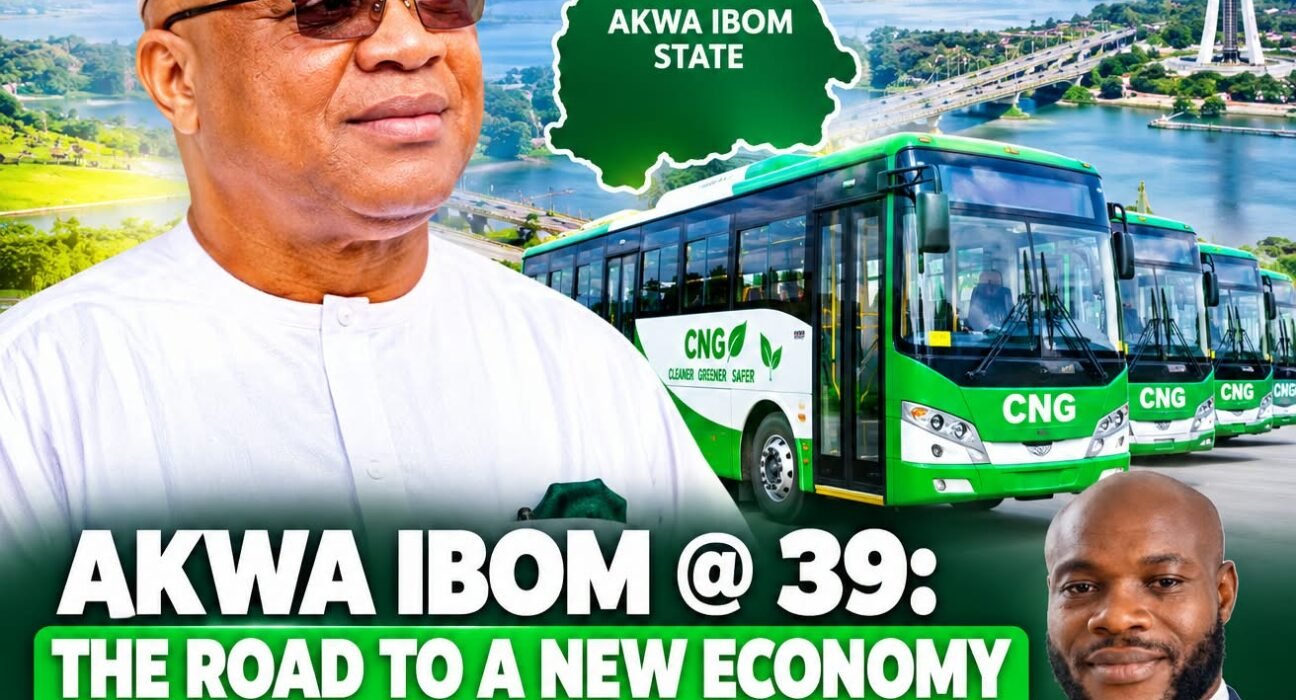
At the grassroots level, the administration’s acquisition of 50 CNG buses, with the first 20 already delivered, brings the transportation agenda directly into the daily lives of citizens.
The stated goal is to provide safer, easier and more efficient public transportation across the state’s 31 local government areas.
But the larger value of the programme lies in what it can unlock.
Affordable and dependable mobility can reduce the cost of economic participation.
A trader can reach a market.
A student can reach school.
A worker can reach employment.
A tourist can reach an attraction.
A small business can reach customers.
The bus, therefore, is not simply a vehicle.
It is an economic instrument.
Governor Eno’s plans to complement the buses with completed terminals, vehicle tracking and modern ticketing are particularly important because sustainable transportation requires systems, not merely assets.
EMPOWERMENT THAT MOVES
The 79 ARISE buses distributed to beneficiaries add another compelling dimension to the administration’s transportation strategy.
Here, transportation becomes both infrastructure and empowerment.
The intervention places productive assets in the hands of citizens and creates the possibility of sustainable income generation.
Commissioner for Transport, Dr. Anthony Luke, has emphasized that the beneficiaries must treat the buses as capital investments requiring accountability, professionalism, maintenance and responsible management.
That principle should remain central.
The success of an empowerment programme is not determined by the ceremony at which assets are distributed. It is determined by what those assets produce years later.
Jobs.
Income.
Businesses.
Family stability.
Economic independence.
That is the real measure of empowerment.
A NEW CULTURE OF TRANSPORTATION
But infrastructure without discipline is unsustainable.
The government’s zero-tolerance approach to one-way driving is therefore not disconnected from the broader transportation agenda.
Dr. Anthony Luke’s direct involvement in sensitization and enforcement operations across Uyo demonstrates that the administration is attempting to combine investment with regulation.
The message is unmistakable: a modern transport system must be governed by modern standards.
Road safety, traffic discipline and professional conduct are not minor administrative concerns. They influence the experience of residents, the confidence of investors and the image presented to visitors.
A tourism destination cannot afford transport disorder.
FROM MOTOR PARKS TO MOBILITY HUBS
The inauguration of a new Management Committee for motor parks is another piece of the institutional puzzle.
Motor parks should be more than chaotic loading points. Properly managed, they can become organized mobility hubs connecting intercity, intra-city and regional transportation.
The new committee, under Hon. Ifiok George, has an opportunity to restore order, improve monitoring and align park operations with the broader objectives of the ARISE Agenda.
But the deeper lesson is institutional.
As the Commissioner observed, government is a continuum.
Projects should not depend on personalities.
Reforms should not end with administrations.
Institutions must be strengthened sufficiently to preserve progress.
THE TOURISM THESIS
This brings us back to tourism.
Akwa Ibom has spent years being recognized for what it possesses.
The next stage is to become recognized for how effectively it connects what it possesses to the world.
A visitor arriving by air should be able to move seamlessly into a reliable road network.
That road network should connect to tourism destinations.
Water transport should expand the visitor’s options.
Regional rail should eventually widen the market.
Hotels, restaurants, artisans, tour operators and local businesses should capture the resulting economic activity.
This is how transportation produces tourism.
And this is how tourism produces jobs.
THE BIGGER TRANSFORMATION
The strongest case for Governor Umo Eno’s transportation agenda is therefore not that Akwa Ibom is acquiring buses, developing airports, expanding marine transportation or participating in rail conversations.
It is that these interventions, if properly integrated and sustained, can help change the economic geography of the state.
They can make Akwa Ibom easier to reach.
Easier to move around.
Easier to invest in.
Easier to trade with.
And ultimately, more attractive to tourists.
That is a much bigger proposition than transportation.
It is economic repositioning.
THE TEST IS WHAT COMES NEXT
The ambition, however, must be matched by execution.
The buses must remain operational.
The terminals must function.
Tracking and ticketing systems must deliver transparency.
Motor parks must remain orderly.
Road safety enforcement must be consistent and fair.
Water transport must meet rigorous safety standards.
Regional rail discussions must translate into practical cooperation.
And tourism must be deliberately connected to the transportation network.
The greatest danger would be to treat these initiatives as isolated accomplishments.
Their greatest promise lies in treating them as components of one strategy.
AKWA IBOM’S NEXT DESTINATION
At 39, Akwa Ibom has an opportunity to make a decisive transition—from a state whose wealth is defined largely by what lies beneath its soil to one whose prosperity is increasingly driven by what it can connect above it.
Its people.
Its markets.
Its coastline.
Its culture.
Its businesses.
Its tourists.
Its neighbouring states.
Its investors.
Its opportunities.
Transportation can become the bridge between all of them.
That is why the most important question for Akwa Ibom at 39 is not simply how much infrastructure has been delivered.
It is:
What kind of economy is that infrastructure designed to create?
If the answer is a more connected, diversified and tourism-driven Akwa Ibom, then the buses, aircraft, boats, roads, terminals and prospective rail corridors are not separate projects.
They are pieces of the same vision.
A vision in which mobility becomes opportunity.
Opportunity becomes enterprise.
Enterprise becomes employment.
And employment becomes prosperity.
At 39, Akwa Ibom is not merely looking back at its journey. It is building the routes to its next destination.
A brand-new world beckons and the road to it begins with connectivity.
Prince Ukpong Idiong Jr,
A public affairs analyst, based in Abuja-Nigeria.