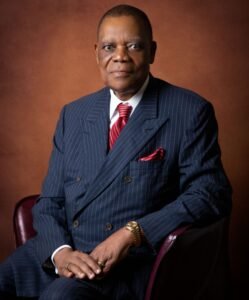
 Atuekong Donatus Obot Etiebet belongs to that distinguished generation of Akwa Ibom sons whose lives have intersected with some of the most important chapters in Nigeria’s story of technological advancement, entrepreneurship, politics and national service.
Scientist, businessman, technocrat, politician and statesman, Don Etiebet, as he is fondly called, has built a remarkable legacy across several fields.
He is particularly celebrated as one of the pioneers of Nigeria’s computer and information technology industry, earning the enduring description of the “Father of Computer in Nigeria.” He later ventured into national politics, founded and led a political party, pursued the Nigerian presidency, and served as Minister of Petroleum Resources at a critical period in the country’s petroleum history.
Etiebet was born on September 15, 1944, in Ikot Ekpuk, Oruk Anam Local Government Area.
His formative years were spent in Akwa Ibom, where he attended Government School, Ikot Ibritan, before proceeding to Holy Family College, Abak, where he obtained his West African School Certificate in 1962. He subsequently attended College of the Immaculate Conception, Enugu, obtaining his Higher School Certificate in 1964.
His academic journey later took him beyond Nigeria to the United Kingdom, where he gained admission to the prestigious Imperial College of Science and Technology, London. Between 1966 and 1969, he studied Petroleum Technology and obtained a B.Sc. Special Honours degree. He proceeded to Canada for postgraduate studies at the University of Western Ontario, where he obtained a Master of Science degree in Applied Geophysics. His training gave him a strong foundation in petroleum exploration, geophysics, earth sciences and the emerging technologies that would later define his professional career.
Before returning permanently to Nigeria, he gained international professional experience. He worked in the oil and mineral exploration industry, including with Shell-NAM in Holland, and was involved in mineral exploration in Canada. He also taught Physics and Applied Geophysics at the University of Western Ontario and, on return, at the University of Ibadan.
It was, however, upon his return to Nigeria in 1971 that Don Etiebet began the entrepreneurial journey that would establish him as one of the country’s foremost technology pioneers.In 1972, he established Earth Sciences Limited, providing geophysical exploration and related services. Recognising the growing importance of computerised data processing to petroleum exploration, he established a computer centre in 1974 for processing geophysical data for government agencies and international oil companies operating in Nigeria. This was a pioneering decision. At a period when computers were still largely unknown outside specialised scientific and corporate circles, Etiebet understood that computer technology would become indispensable to modern administration, business, education, banking, telecommunications and industry.
In 1979, the computer methods division of Earth Sciences Limited developed into Data Sciences Nigeria Limited (DSNL). The company became involved in the supply, installation and maintenance of computer hardware and software systems, including systems associated with Digital Equipment Corporation (DEC) of the United States.
The company expanded beyond petroleum applications into public administration, education, examination processing, banking, utilities, telecommunications and other sectors.
Through this pioneering work, Etiebet helped introduce computerisation to important areas of Nigerian national life.
His contribution went beyond business. He helped establish a professional ecosystem around computing and information technology in Nigeria and served as President of the Nigeria Computer Society from 1983 to 1987. He also became a Life Fellow of the Society. Between 1990 and 1993, he also developed and marketed the first Nigerian-branded personal computer, the Obodex PC.It was this combination of technological foresight, entrepreneurship and institution-building that earned him his enduring reputation as a father of Nigeria’s computer industry.
His involvement in politics dates back to the late 1970s. He became increasingly active in national political affairs and eventually emerged as one of the influential political leaders from Akwa Ibom and the South-South region.
His political journey reached a defining point during Nigeria’s difficult transition years of the 1990s.In 1996, Etiebet founded and nurtured the National Centre Party of Nigeria (NCPN), one of the political parties registered during the military transition programme. He used the platform to pursue his ambition of becoming President of Nigeria. Contemporary accounts describe him as one of the few political figures who openly sought to challenge the political order of the period. His ambition was ultimately frustrated when the transition programme was terminated and his political activities came under pressure. He was arrested and detained in 1997, and his presidential ambition was effectively brought to an end under the military regime.
With the return of democracy, Etiebet became one of the founding figures associated with the Peoples Democratic Party (PDP). He was a member of the party’s leadership and contested its presidential nomination in 1999, although he was not chosen as the party’s presidential candidate. He subsequently served on the PDP presidential campaign team that helped secure the party’s victory in the 1999 general election.
Before then, his technological and professional background in petroleum and geophysics converged with national service when he was appointed Minister of Petroleum and Mineral Resources in August 1993, serving until February 1995. Before becoming Minister, he had also served as Secretary for Petroleum and Mineral Resources in the Interim National Government.His tenure placed him at the centre of Nigeria’s most strategically important economic sector.
Among the initiatives associated with his period in office was the relaunching of the Nigeria Liquefied Natural Gas (NLNG) project, as well as reforms intended to make petroleum-sector institutions more effective. He is also credited with introducing monetisation measures in the Nigerian National Petroleum Corporation and restructuring the Department of Petroleum Resources to improve its effectiveness.
Don Etiebet’s influence has not been confined to political office.He has served in several professional and institutional capacities, including as Chairman of the UNESCO Intergovernmental Bureau for Informatics Regional Training Centre for English-speaking African States, President of the Nigeria Computer Society, pioneer member of the Board of the Nigeria Communications Commission and member of several national science, technology and economic development bodies.He also served as Pro-Chancellor and Chairman of the Governing Council of the University of Jos from 2013 to 2017.
As Akwa Ibom celebrates 39 years of Statehood, Atuekong Donatus Obot Etiebet, Commander of the Order of the Niger, CON, deserves this recognition among the State’s foremost leading lights.